Antique Turkmen Tribal Gul Rug
Description
Overview
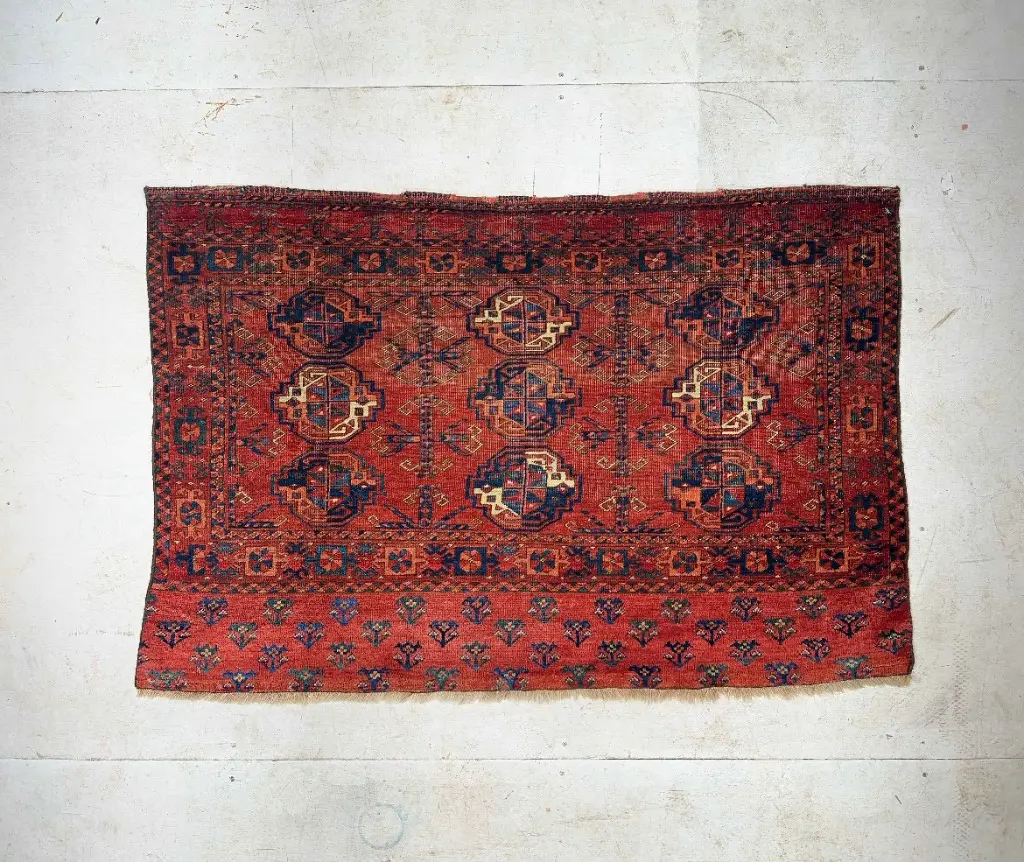
This antique Turkmen tribal rug is a compact, richly patterned example of the gul medallion tradition long associated with the nomadic weaving cultures of Central Asia. Measuring approximately 3 feet by 4 feet 7 inches, the rug is hand-knotted in wool and presents rows of octagonal gul medallions across a deep madder-red field, framed by narrow geometric guard borders and a band of stylized botehs along one end. Catalogued in our inventory as Rug No. 11117, it is offered as an antique piece.
Design & Motifs
The field is organized in the classic Turkmen manner: columns of stacked octagonal guls, each quartered internally and outlined in indigo, set against a warm brick-red ground. This repeating medallion, known as the gul (from the Persian word for "flower" or "rose"), functioned historically as a kind of woven signature — different Turkmen tribal groups, among them the Tekke, Yomut, Ersari, and Salor, each favored their own gul geometry. The specific tribal attribution of this piece has not been confirmed. A narrow band of stylized botehs runs along one end, while the guard borders carry a repeating rosette-and-diamond lattice, both common framing devices in Turkmen weaving.
Materials & Construction
The rug is hand-knotted, a construction method clearly visible in close-up photography of the reverse side, where individual knot rows are legible through the foundation. The pile appears to be hand-spun wool, consistent with traditional Turkmen practice, though the specific fiber content of the warp and weft has not been independently verified for this catalog entry. Historically, Turkmen weavers worked largely from local materials — wool from their own flocks and dyes drawn from madder root, indigo, and other plants — and this rug's saturated, slightly variegated palette is consistent with that tradition, though whether its dyes are natural or synthetic has not been confirmed.
Condition & Restoration
The rug presents in good, presentable condition consistent with its age. Photography of the reverse shows a canvas reinforcement strip along one edge, suggesting some prior conservation work, though formal restoration records are not on file for this piece. The fringe is intact and the corners lie flat.
Ideal Placement
At roughly 3' x 4'7", this rug suits smaller footprints — an entryway, a reading nook, beside a bed, or layered atop a larger neutral rug in a living room. Its saturated red tone and dense geometric pattern make it a natural accent in spaces with simpler, more neutral surrounding decor, where the gul pattern can read clearly rather than compete with other busy elements.
Why This Rug Is Special
Small-format antique Turkmen rugs like this one are increasingly scarce, and each carries the visual signature of a specific weaving lineage in its gul design. Beyond its decorative appeal, this piece is a handmade record of a textile tradition recognized by UNESCO as an element of intangible cultural heritage — one where pattern, color, and technique were passed down through generations rather than mass-produced. For collectors and design-conscious buyers alike, it offers both a functional accent rug and a tangible piece of Central Asian weaving history.
The Story Behind This Rug
The Turkmen Weaving Tradition
Turkmen rugs originate from the nomadic and semi-nomadic Turkmen tribal confederations of Central Asia, a region spanning present-day Turkmenistan and extending into parts of Afghanistan, Uzbekistan, and northern Iran. For centuries, weaving was a central domestic craft among Turkmen women, who produced not only large-format rugs but also tent furnishings and trappings — door hangings, storage bags, tent bands — all made on portable looms suited to a mobile way of life.
Design, Symbolism & Materials
The most recognizable feature of Turkmen weaving is the gul, a repeating medallion whose name derives from the Persian word for "flower" or "rose," even though the motif itself is almost always geometric and octagonal rather than floral. Historically, each major Turkmen tribal grouping — among them the Tekke, Yomut, Salor, Ersari, and Saryk — developed its own distinctive gul geometry, to the point that specialists can often identify which tribal group produced a given rug by examining the proportions and internal structure of its medallions. In this sense, the gul functioned as a woven tribal signature embedded into everyday textiles.
Color in traditional Turkmen weaving
Color in traditional Turkmen weaving came from locally available materials: wool sheared from the weavers' own flocks, and dyes derived from plants such as madder root (for the deep reds that dominate most Turkmen rugs) and indigo (for blues), supplemented with other natural, and in later periods synthetic, dyestuffs. The resulting palette — saturated reds grounding cooler blues and warm ivory highlights — remains one of the most identifiable characteristics of the tradition.
Trade History & The Bukhara Label
Much of what the West came to call "Bokhara" rugs are, in fact, Turkmen weavings that passed through the historic Silk Road trading city of Bukhara (in present-day Uzbekistan) on their way to international markets, rather than rugs woven in Bukhara itself. This trade history explains the persistence of "Bokhara" as a market label for Turkmen-style rugs even today.
Cultural Heritage & UNESCO
In 2019, traditional Turkmen carpet weaving was inscribed on UNESCO's Representative List of the Intangible Cultural Heritage of Humanity — formal recognition of a craft practice passed down through generations for over a thousand years. Each piece, including smaller-format rugs like this one, represents an individual weaver's execution of an inherited design vocabulary, making every antique Turkmen rug both a functional textile and a document of a specific place, tribal lineage, and moment within a living weaving tradition.
Specifications
See This Rug in Person
Visit our Cambridge showroom to see the weave and colors in natural light. Tell us when you would like to come and we will have the rug ready for you.
Book a visit to see this rug
769 Concord Ave, Cambridge, MA 02138
617-868-6667 · info@noororientalrugs.com
Tue, Wed, Fri, Sat: 8:00 AM – 3:00 PM
Additional Services & Consultations
Purchase With Confidence
Individually Inspected
Every rug is carefully examined by our specialists for authenticity, craftsmanship, and overall condition before being added to our collection.
Professionally Washed & Restored
Our rugs are professionally hand washed using traditional methods and restored only where necessary to preserve their beauty and structural integrity.
One of a Kind
Every handmade rug is unique. Once sold, this exact piece cannot be replaced.
Expert Consultation
Our specialists are available to answer questions, provide additional photographs, discuss room placement, and schedule private showroom visits.
Frequently Asked Questions
Is this rug handmade?
Is this rug one of a kind?
What materials are used?
Has this rug been professionally washed or restored?
Can I view this rug in person?
Do you provide additional photographs or videos?
How should I care for this rug?
Can Noor Oriental Rugs help with future cleaning or restoration?
Similar Handmade Masterpieces
Our specialists selected these rugs based on similar craftsmanship, weaving traditions, design language, and overall character.
Experience This Rug In Person
We invite you to view this rug at our showroom in Cambridge, MA (just outside Boston). Feel the texture, inspect the weave, and see the colors in true light. We also offer a complimentary 3-day in-home trial.
Book a visit to see this rug