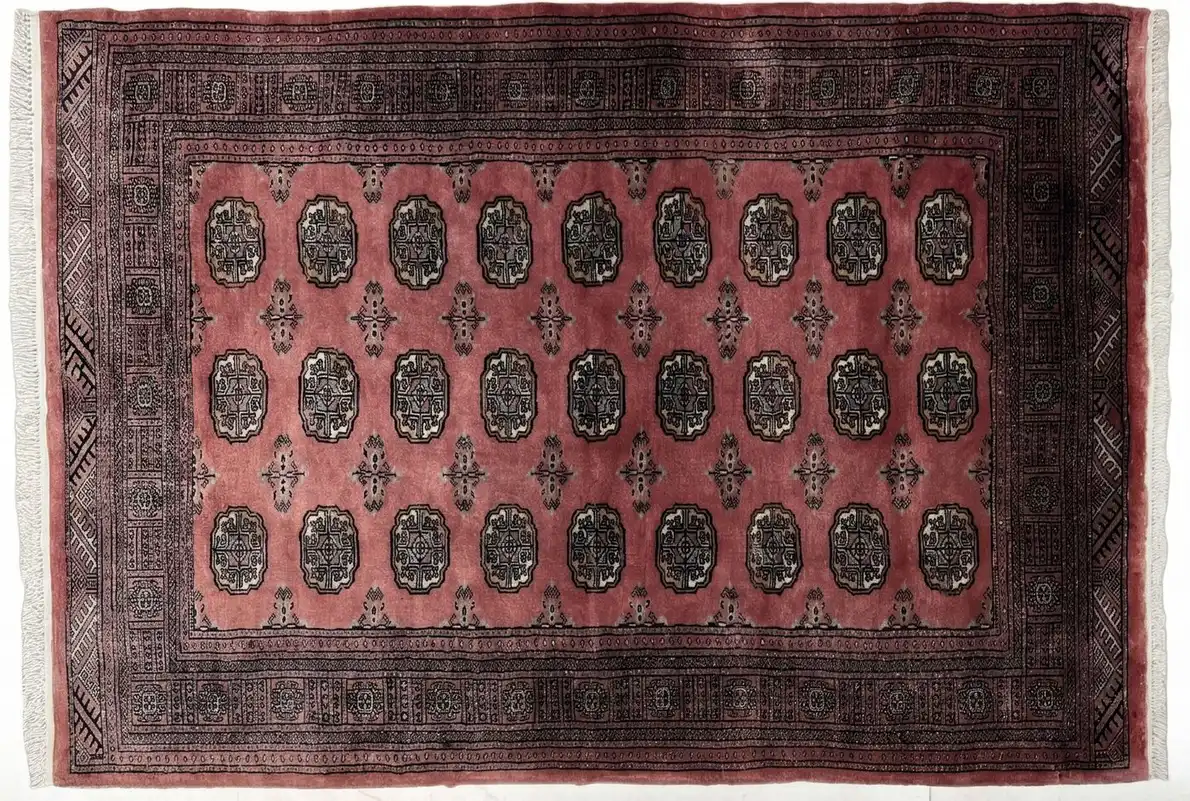
Royal Bokhara Rug, 4'2" x 5'11"
Description
Overview
This rug is woven in the Royal Bokhara pattern, a well-known design within the broader Bokhara (Turkmen-derived gul) family of rugs. It presents three columns of elongated octagon medallions, each quartered by intersecting lines, repeated in even rows across a soft rose-pink field and framed by a wide, densely patterned charcoal-and-black border with multiple guard stripes. At 4'2" x 5'11", it is a mid-size room accent.
Design & Motifs
The field carries the design that gives the "Royal" Bokhara its name: rows of elongated octagons, each divided into quarters by crossing lines, alternating with small cross-shaped diamond devices between medallions. This differs from the "Princess" Bokhara, a smaller prayer-rug format in the same design family. The wide border combines several guard stripes of repeating rosettes and diamond lattice with a bold outer band of stepped diagonal motifs, all rendered in dark charcoal, black, and muted rose against the field's warm pink-rose ground.
Materials & Construction
The rug is hand-knotted, with the pile and knot structure visible in the close-up photography supplied. Rugs of this pattern are most commonly woven with a wool pile on a cotton foundation, a combination widely used in Pakistani production of the Bokhara design since the mid-20th century. According to our inventory records, this piece was woven in Pakistan with a lamb wool pile on a cotton foundation.
Condition & Restoration
The rug presents as clean and even in the supplied photography, with no visible damage, staining, or obvious repair. It has been hand-washed with green shampoo and restored in our workshop.
Ideal Placement
At 4'2" x 5'11", this rug suits a small living room seating area, a den, a bedroom, or a hallway. Its warm rose-pink ground and dark, dense border read as a classic, versatile neutral in traditional and transitional interiors alike.
Why This Rug Is Special
The Royal Bokhara windowpane pattern is one of the most recognizable design families in the oriental rug trade, tracing its motif lineage to Turkmen gul medallions and popularized through 20th-century Pakistani weaving production. A well-executed example like this one offers the crisp, orderly geometry and restrained palette that has made this pattern a long-standing favorite for traditional interiors.
The Story Behind This Rug
The Bokhara Weaving Tradition
"Bokhara" (also spelled Bukhara) takes its name from the historic Silk Road city of Bukhara, in present-day Uzbekistan — a major trading center through which Central Asian carpets passed on their way to international markets. In the rug trade, however, "Bokhara" refers less to rugs actually woven in that city and more to a design tradition: repeating gul medallions originally associated with Turkmen tribal weaving, most recognizably the Tekke tribe's octagonal gul.
The specific "Royal Bokhara" pattern seen in this rug — rows of elongated octagons, each quartered by crossing lines — is a named design within this family, distinguished in the trade from the "Princess Bokhara," a smaller prayer-rug format woven with a similar medallion vocabulary.
Much of the Bokhara-pattern production familiar in the West today was, and continues to be, woven not in Central Asia but in Pakistan. Following the partition of British India in 1947, Muslim weavers who relocated to Pakistan worked alongside Turkmen weaving communities, and the Pakistani government established training programs and organized workshops to build a carpet-weaving export industry. Because of its comparatively straightforward, repeating structure, the Bokhara gul design was among the first patterns used to train weavers in these programs, and it went on to become one of the most widely produced and recognized rug patterns associated with Pakistani weaving — commonly woven with a wool pile, sometimes blended with New Zealand wool, on a cotton foundation.
As a result, a rug in the Royal Bokhara pattern may originate from a range of production contexts, and the specific weaving origin of this individual piece has not been confirmed.
Specifications
See This Rug in Person
Visit our Cambridge showroom to see the weave and colors in natural light. Tell us when you would like to come and we will have the rug ready for you.
Book a visit to see this rug
769 Concord Ave, Cambridge, MA 02138
617-868-6667 · info@noororientalrugs.com
Tue, Wed, Fri, Sat: 8:00 AM – 3:00 PM
Additional Services & Consultations
Purchase With Confidence
Individually Inspected
Every rug is carefully examined by our specialists for authenticity, craftsmanship, and overall condition before being added to our collection.
Professionally Washed & Restored
This rug has been professionally hand washed using traditional methods and restored only where necessary to preserve its beauty and structural integrity.
One of a Kind
Every handmade rug is unique. Once sold, this exact piece cannot be replaced.
Expert Consultation
Our specialists are available to answer questions, provide additional photographs, discuss room placement, and schedule private showroom visits.
Frequently Asked Questions
Is this rug handmade?
Is this rug one of a kind?
What materials are used?
Has this rug been professionally washed or restored?
Can I view this rug in person?
Do you provide additional photographs or videos?
How should I care for this rug?
Can Noor Oriental Rugs help with future cleaning or restoration?
Similar Handmade Masterpieces
Our specialists selected these rugs based on similar craftsmanship, weaving traditions, design language, and overall character.
Experience This Rug In Person
We invite you to view this rug at our showroom in Cambridge, MA (just outside Boston). Feel the texture, inspect the weave, and see the colors in true light. We also offer a complimentary 3-day in-home trial.
Book a visit to see this rug