Yağcıbedir Turkish Rug
Description
Overview
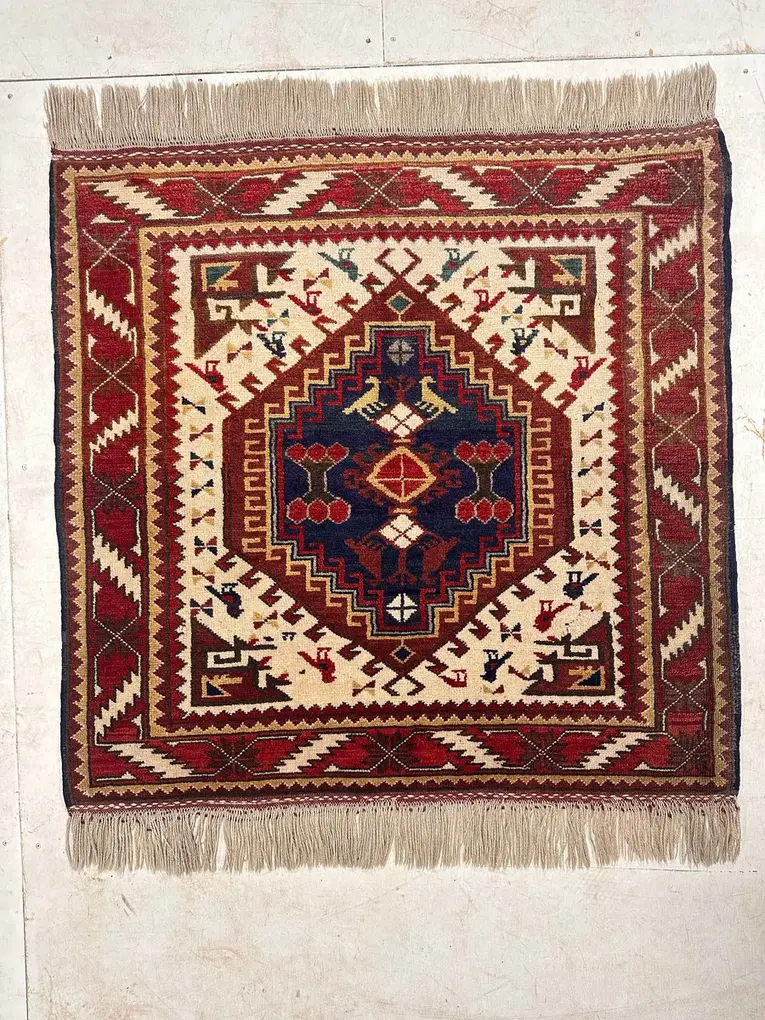
This rug is a hand-knotted example of the Yağcıbedir weaving tradition of Western Anatolia, Turkey. Measuring 3'4" x 3'5" — a nearly square format historically associated with dowry pieces — it presents a stepped octagonal medallion in madder red and indigo on an ivory ground, populated with stylized birds and paired ram-horn (koçboynuzu) motifs, and framed by concentric geometric guard borders. Catalogued in our inventory as Rug No. 303, its intake tag lists the design as "GEO" (geometric) and the quality grade as "Super."
Design & Motifs
The field is centered on a large stepped medallion outlined in a red-and-gold zigzag band, containing a navy ground scattered with diamond lattice, small paired birds, and hooked ram-horn forms rendered in red, brown, and ivory. The corners of the field carry secondary geometric devices in dark brown and cream, echoing motifs used elsewhere in Western Anatolian weaving. The outer borders combine a wide madder-red band of stepped diamonds with narrower guard stripes in cream, gold, and navy — a restrained, high-contrast palette characteristic of Yağcıbedir work.
Materials & Construction
The rug is hand-knotted in wool, with individual knots and the reverse foundation clearly visible in the supplied macro and reverse-side photography. Traditional Yağcıbedir weaving is known for a notably high knot density and wool that is hand-spun and naturally dyed by the weavers themselves; whether this specific piece follows natural or synthetic dyeing has not been confirmed. According to our inventory records, the pile, warp and weft are all wool, and the dyes are colorfast.
Condition & Restoration
The rug presents in good condition in the supplied photography, with an intact fringe and no visible major damage, staining, or repair. It has been hand-washed with green shampoo and restored in our workshop.
Ideal Placement
At roughly 3'4" x 3'5", this nearly square rug suits an entryway, in front of a fireplace, beside a bed, or as an accent within a larger seating arrangement. Its high-contrast red, ivory, and navy palette and dense geometric medallion make it a strong focal point in simpler, more neutral surroundings.
Why This Rug Is Special
Yağcıbedir rugs are a distinct, named weaving tradition tied to a specific cluster of villages in the Sındırgı district of Balıkesir province — not a generic label, but a recognizable regional style prized for its disciplined red-white-navy color scheme and fine, dense knotting. Originally woven as dowry pieces, each carries a domestic, personal history within the weaving culture it comes from. A well-preserved, nearly square example like this one offers both a strong graphic presence and a tangible connection to a specific, documented Anatolian weaving village tradition.
The Story Behind This Rug
The Yağcıbedir Weaving Tradition
Yağcıbedir is not the name of a single town but a label for a distinct type of carpet woven by Yörük (nomadic Turkish) weavers in and around Sındırgı, in the Balıkesir province of Western Anatolia. The tradition is associated with a specific cluster of villages — among them Esmedere, Çakıllı, Karakaya, Alacamescit, and Eğridere — where weaving was passed down through generations as a domestic, village-based craft rather than a large commercial workshop industry.
Historically, Yağcıbedir rugs were woven primarily as dowry pieces: textiles a young woman would weave and bring into her marriage, intended for use within the home rather than for immediate sale. This domestic origin shaped the format of many surviving pieces, which are often small to medium in size — including the nearly square, compact proportions seen in this rug — rather than room-sized carpets woven for a trade market.
The most distinctive feature of Yağcıbedir weaving is its restrained, high-contrast color palette: madder red, undyed ivory or cream wool, and deep indigo-navy, occasionally set off with small amounts of brown or gold. Traditionally, weavers spun their own wool and dyed it using natural, plant-based dyes, a practice tied to the same local, self-sufficient production methods used throughout rural Anatolian weaving. Designs are geometric rather than curvilinear, built from stepped medallions, hooked border devices, and stylized figures — including birds and the paired "ram's horn" (koçboynuzu) motif seen in this rug — that recur throughout Turkish tribal and village weaving as symbols of fertility, protection, and continuity, though their precise original meanings vary by region and are not uniformly documented.
Yağcıbedir carpets are also noted among specialists for their unusually high knot density relative to other village weavings of the region, a technical hallmark that produces the crisp, precise geometry visible in well-preserved examples. As with many named regional weaving traditions, the label "Yağcıbedir" is sometimes applied loosely in the trade to rugs woven in a similar style outside the original village cluster; the specific workshop or village origin of this particular rug has not been independently confirmed.
Specifications
See This Rug in Person
Visit our Cambridge showroom to see the weave and colors in natural light. Tell us when you would like to come and we will have the rug ready for you.
Book a visit to see this rug
769 Concord Ave, Cambridge, MA 02138
617-868-6667 · info@noororientalrugs.com
Tue, Wed, Fri, Sat: 8:00 AM – 3:00 PM
Additional Services & Consultations
Purchase With Confidence
Individually Inspected
Every rug is carefully examined by our specialists for authenticity, craftsmanship, and overall condition before being added to our collection.
Professionally Washed & Restored
This rug has been professionally hand washed using traditional methods and restored only where necessary to preserve its beauty and structural integrity.
One of a Kind
Every handmade rug is unique. Once sold, this exact piece cannot be replaced.
Expert Consultation
Our specialists are available to answer questions, provide additional photographs, discuss room placement, and schedule private showroom visits.
Frequently Asked Questions
Is this rug handmade?
Is this rug one of a kind?
What materials are used?
Has this rug been professionally washed or restored?
Can I view this rug in person?
Do you provide additional photographs or videos?
How should I care for this rug?
Can Noor Oriental Rugs help with future cleaning or restoration?
Similar Handmade Masterpieces
Our specialists selected these rugs based on similar craftsmanship, weaving traditions, design language, and overall character.
Experience This Rug In Person
We invite you to view this rug at our showroom in Cambridge, MA (just outside Boston). Feel the texture, inspect the weave, and see the colors in true light. We also offer a complimentary 3-day in-home trial.
Book a visit to see this rug