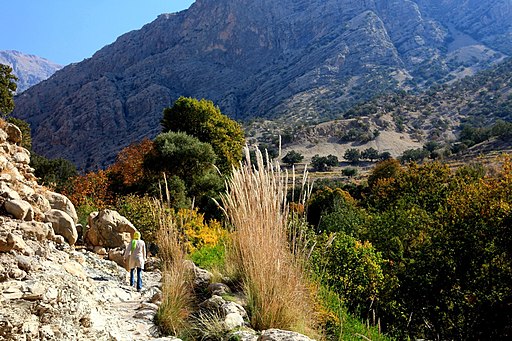
A handmade rug begins long before the first knot is tied. It begins on a mountainside, in the fleece of a sheep. Geography and climate have played a paramount role in the development of rug types as we know them today, and nowhere is that clearer than in the wool itself. The highlands of the Zagros Mountains, spanning through Persia and Khuzestan, provide optimal conditions for raising sheep with exceptionally thick, resilient coats rich in lanolin. That fleece is the reason a fine Persian rug can be walked on for a lifetime and still grow more beautiful with age.
This is what mountain wool is, how it becomes yarn, and how to recognize it in a rug.
1. Why the mountains change the fleece
A sheep grows the coat its climate demands. In the highlands, cold winters, thin air and wide swings between day and night temperatures push the animal to grow a dense, long fleece with a high lanolin content. Lanolin is the natural oil in wool, and it is the quiet workhorse of a good rug: it coats each fiber, repels water and dirt before they can sink in, and gives the finished yarn its softness and its luster.
Lowland sheep, kept in warmer and wetter country, grow a different fleece — often shorter, coarser and leaner in lanolin. It still makes a rug, but not the same rug. The fiber is less resilient underfoot, it takes dye less deeply, and it wears faster. That is why the best-known weaving regions have always been tied to particular highland flocks, and why a rug's wool is worth asking about in the same way you would ask about its knots.
2. From fleece to yarn
Good wool is shorn in spring, when the winter fleece has reached its full length. The raw fleece is washed to remove dirt while keeping enough of its natural lanolin, then carded — combed out so the fibers lie in one direction — and spun into yarn.
The spinning is where hand and machine part ways. Hand-spun yarn is spun by hand, usually by women in the weaving villages, and it is never perfectly even. Its thickness varies slightly along its length, and that variation is not a flaw. It is what gives a hand-knotted rug its living surface: the pile catches the light unevenly, the colors shift gently, and the rug never looks stamped out by a machine. Machine-spun yarn is perfectly uniform, and a rug made from it looks uniform too — flat, even, and a little lifeless by comparison.
At Noor, the rule for restoration follows the same logic: the wool is hand-spun, as the original rug's wool is also hand-spun. A machine-spun repair yarn would sit differently in the pile and show itself over time.
3. Not all wool is equal: kurk and the finest fleeces
Within a single fleece, the finest wool comes from the shoulder and neck of a young sheep. Rug people call this kurk wool, and it is among the finest the rug world has to offer: soft, lustrous and at the same time durable. The great city workshops — in places such as Nain and Isfahan — have long sought it out for their finest pieces, where a fine, soft yarn is needed to carry a detailed pattern.
You do not need to memorize wool grades to buy well. But it helps to know that when a dealer talks about a rug's wool, the claim behind the words is usually one of these: the sheep lived high, the fleece was long and lanolin-rich, and the yarn was spun by hand. If a rug is described as made from kurk wool, ask which part of the animal it came from and why it was chosen for that rug — a seller who knows the answer knows the rug.
4. Wool, silk and cotton: each has its job
Wool is the pile of most Persian rugs, but it is rarely the whole rug. The foundation — the warp and weft threads the knots are tied around — is usually cotton, which is strong, stable and takes a straight line, so the rug keeps its shape. Fine rugs may use silk, in the pile or as a highlight: silk is finer than wool, so it can carry the smallest details of a pattern, and it shines where wool glows.
The combination matters. A wool pile on a cotton foundation is the classic working rug: resilient underfoot, forgiving of daily use, and able to be cleaned and repaired again and again. A silk rug is a different creature — finer, more delicate, and best in a room where it will be admired more than walked on. When you look at a rug, ask what each fiber is doing. If the answer is "all wool" or "all silk" without a reason, keep asking.
5. How wool takes color — and why it ages so well
This lanolin-rich highland wool yields fibers that are strong, naturally stain-resistant, and possess a natural luster when dyed. The reason is in the fiber itself. Wool absorbs natural dye deep into its core, rather than wearing it on the surface, so the color has depth: it changes with the light, it softens rather than fading flat, and it develops abrash — the gentle variation of shade within a single color that comes from dyeing yarn in small batches. Our guide to Persian and Oriental rugs explains how the dyers work.
That is also why an old wool rug looks better than a new one. With years of use, the pile is pressed and polished by footsteps, the lanolin keeps working, and the surface takes on a sheen that no new rug has. Using these regional wools ensures the rug outlives generations while growing softer and more beautiful over time. A synthetic rug does the opposite: its color sits on the surface, it fades evenly, and it never develops a patina, because there is nothing in the fiber to age.
6. How to judge wool in a rug you are considering
You do not need a laboratory. Your hands will tell you most of what matters.
- Feel it. Good wool feels soft and springy, not rough, plasticky or slippery. Press the pile down with your palm and let go: it should spring back rather than staying flat.
- Look at the back. The knots should be visible and slightly irregular, row by row — the sign of hand-spun yarn and hand knotting together.
- Bend it. A wool rug bends easily and the pile does not crack or shed in clumps. A little shedding in the first months is normal for a new wool rug; heavy, continuing shedding is not.
- Ask where the wool came from. "Highland wool" should mean a place, not just a word. The Zagros, and the region a particular rug was woven in, are the answers that count. At Noor we use only wool from the same region where the rug is woven, and that rule is the first of our Ten Rules of restoration.
- Smell it, lightly. Clean wool has a faint, natural lanolin smell. A strong chemical smell is a warning that the rug was treated or is not wool at all.
7. Wool in restoration: matching the original
When an old rug is repaired, the wool matters as much as the knots. A patch woven with the wrong wool will show itself within a few years: it will wear at a different rate, take cleaning differently, and sit at a different height in the pile. That is why restoration at Noor starts with matching the fiber — wool from the same region, hand-spun, dyed in organic solutions, in several shades spun together so the repair carries the same patina of age as the rug around it.
If you are having a rug restored anywhere, ask the restorer what wool they will use and where it comes from. If they cannot answer, the repair is a guess, however neat the knots look on the day.
8. Caring for wool, briefly
Wool is forgiving, but it is not indestructible. Vacuum regularly without a beater bar on a fine pile, rotate the rug so wear is even, and keep it dry: wool can handle a spill if it is blotted quickly, but long dampness invites moths and mildew. Moths are the real enemy of wool — they eat the fiber, not the dirt — so a rug stored away should be clean, dry and checked. Our article on moth damage in wool rugs explains the signs and how to keep moths away. For a full wash, a professional hand wash is the safe choice; a wool rug should never go into a machine or be soaked in harsh detergent. If you are storing a rug from a family estate, our guide to what to do with an inherited rug covers it step by step.
The short version
Mountain wool is not a marketing word. It is a fleece grown in a hard climate, rich in lanolin, spun by hand and dyed deep — and it is the reason a handmade rug survives generations of footsteps and still looks better at fifty than it did at five. When you buy a Persian rug, you are buying that wool as much as the pattern. Ask where it came from, feel how it springs back, and look at how it has aged. The fleece will tell you the truth about the rug.