A kilim is a handmade rug with no pile. Instead of tufts of wool tied into knots, the colored weft threads themselves form the design as they are woven tightly in and out of the warp threads. The result is a thin, light, flat rug, often reversible, and usually bold and geometric. Kilims have been woven for centuries across a wide region, from Turkey and the Balkans through Iran and the Caucasus to Central Asia, and they are among the most versatile rugs you can own.
This guide explains how a kilim is made, how it differs from a pile rug, how to tell a good one, and how to care for it.
How a kilim is woven
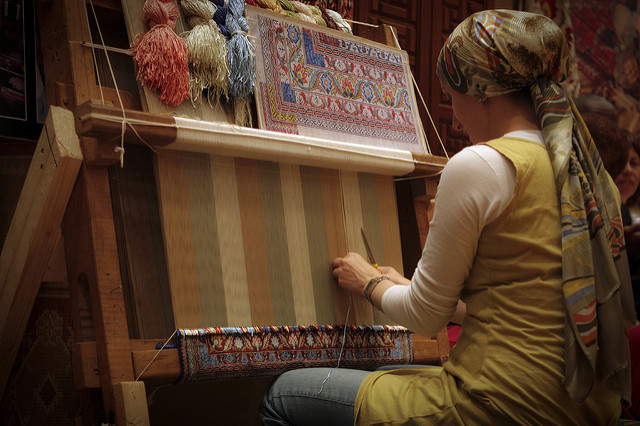
Every handmade rug starts with warp threads strung on a loom. In a pile rug, such as a Persian, the weaver ties knots of wool around pairs of warps, row by row, and cuts them to form the soft pile. Our guide to how rugs are woven shows the difference.
In a kilim, there are no knots. The weaver passes colored weft threads over and under the warps and packs them down tightly, so the warps are hidden and the colored wefts form the surface. Each color is woven only where it is needed in the design, and then turned back.
Where two colors meet along a vertical line, the weaver has a choice. If the wefts simply turn back on their own warps, a small slit opens between the two colors. These slits are a hallmark of many kilims, and they are why kilim designs favor diagonals, steps and diamonds, which avoid long vertical joins. Other weavers interlock or share the wefts where colors meet, which closes the slit.
Kilim vs pile rug
- Surface: a kilim is flat, with no pile; a pile rug has a soft pile of cut knots.
- Weight: a kilim is thin and light; a pile rug is thicker and heavier.
- Back: a kilim is often reversible; on a pile rug the pattern shows on the back, but the pile is only on the front.
- Design: kilims are bold and geometric; pile rugs can be geometric or curving, with fine detail.
- Weaving time: a kilim is usually faster to weave than a pile rug of the same size.
Neither is better. They are different kinds of rug, each with its own weaving and repair techniques. A fine antique kilim can be a serious work of art, and a good new kilim is a handmade textile in its own right.
Where kilims are woven
Kilims are woven wherever rugs are woven: in Turkey (Anatolia), in Iran, in the Caucasus, in Afghanistan and Central Asia, and in North Africa and the Balkans, each region with its own colors and motifs. Many of our kilims were woven in Turkey, and each rug's page lists its size, materials and origin. See our kilim rugs and runners.
Why people love kilims
- Light and easy to move. A kilim can be lifted, shaken out, turned and moved far more easily than a pile rug of the same size.
- Bold design. Strong geometric patterns and clear colors work well in modern and traditional rooms alike.
- Layering. A kilim lies flat, so it can be layered over a larger rug or wall-to-wall carpet.
- Doors and furniture. A flat rug lets doors open over it and chairs slide on and off it.
- Runners. Kilims make excellent runners for hallways and kitchens, and many of ours are runners. See our guide to what size rug for each room.
How to tell a good kilim
- Look for a tight, even weave. The wefts should be packed firmly, so the warps are hidden and the rug feels solid, not loose or limp.
- Check that it lies flat. Some waviness is normal in a handwoven rug, but a kilim that ripples badly or curls at the edges may have been woven under uneven tension.
- Look at the colors. Natural dyes give gentle variations of shade, called abrash. Harsh, flat color can be a sign of synthetic dyes. Read more in our article on natural dyes.
- Check the ends and sides. The warps at the ends should be secured, and the sides should be firm and even.
- Ask about origin, age and materials, and get them in writing. Every rug we sell comes with a certificate of authenticity. Our article on how to tell an authentic handmade rug explains what else to check.
Caring for a kilim
Because a kilim has no pile, dirt sits near the surface rather than sinking deep, and regular, gentle vacuuming keeps it clean. Vacuum without a beater bar, which can catch the wefts.
- Use a rug pad. A kilim is light and can slip on a hard floor; a pad stops it moving and protects it. See rug pads for hardwood floors.
- Turn it now and then so it wears evenly, and, if it is reversible, use both sides.
- Keep it out of strong, direct sun for long periods, as with any naturally dyed rug.
- Take care with spills. Blot right away with cool, clean water only. Kilims can be more prone to color run than pile rugs, because the colored wefts are right at the surface.
- Have it washed by hand. Gentle hand cleaning, with color testing first, is the safe way to wash a kilim.
Repairing a kilim
Kilims wear differently from pile rugs. The common problems are worn or broken wefts, open slits that have spread, holes, loose ends and moth damage. Because there is no pile to hide a repair, a kilim needs a restorer who reweaves the wefts in matching wool and colors. A damaged kilim can be restored: one of our customers wrote that after we restored a kilim badly damaged by moths, one would never know the terrible shape it was in. See our Oriental rug restoration and repair page and our article on moth damage in wool rugs.
Frequently Asked Questions
What is the difference between a kilim and a rug?
A kilim is a kind of rug: a flatweave with no pile, where the colored weft threads form the design. A pile rug, such as a Persian, is made of knots of wool tied around the warps and cut to form a soft pile.
Are kilim rugs reversible?
Many are. Because the design is woven into the wefts rather than tied in knots, it often shows almost equally on both sides, so a kilim can be turned over to share the wear.
Are kilims durable?
A well-woven kilim with good wool is durable and lasts for many years, especially with a rug pad and regular, gentle vacuuming. Because it has no pile, it shows wear sooner than a thick pile rug in the busiest spots.
Do kilims slip on hardwood floors?
They can, because they are light and flat. A rug pad stops a kilim slipping and protects the floor.
Can a damaged kilim be repaired?
Yes. Worn wefts, holes, open slits and moth damage can be rewoven in matching wool and colors. Send us photos for a free evaluation.