"Antique", "semi-antique", "vintage", "old", "estate": rugs are described with many words for age, and they are not always used the same way. Yet age is one of the biggest factors in a rug's value, and one of the easiest to exaggerate. Knowing what each word should mean helps you understand what you are looking at, whether you are buying, insuring or inheriting a rug.
This guide explains the terms, how age affects value, and what to check before you buy a pre-owned rug.
What the words mean
- Antique: generally a rug about 100 years old or more. Most antique Oriental rugs on the market today were woven in the late 19th or early 20th century.
- Semi-antique: generally a rug of roughly 50 to 100 years old: old enough to have softened and mellowed, but not yet antique.
- Vintage: a looser word, often used for pre-owned rugs from the mid-20th century onward. It describes a used rug with some age, not a precise date.
- Old: a general description, used for rugs that have clearly aged but are not dated more precisely.
- Estate: describes where a rug came from, usually a household or estate sale, not its age. An estate rug can be antique or quite recent.
- New or modern: woven recently, usually within the last few decades.
Most rugs are dated within a range, such as "late 19th century" or "mid-20th century", because rugs were rarely signed or dated. Our article on how a rug's age and origin are found explains how an appraiser reaches those ranges.
How age affects value
A good antique rug is scarce: no more will ever be made. Age is of high value in old rugs, and collectors prize the softened colors and gentle abrash that natural dyes develop over decades. But age adds value only when it comes with quality and sound condition.
- Condition matters as much as age. Worn pile, moth damage, holes, missing fringe, a cut-down size and faded or run colors all reduce value.
- Quality matters more than age. An old rug that was coarse when new is still coarse. A fine rug from a good weaving center keeps its appeal.
- Origin matters. An antique Persian, Caucasian or Turkmen rug is valued differently from a semi-antique Persian-style rug from elsewhere. See types of Oriental rugs.
- Honest wear is different from damage. Even, gentle wear is part of an antique's character, and many collectors value it, as we explain in Beautiful "Flaws" in Persian Rugs.
Signs a rug is genuinely old
- Softened, mellow colors with gentle abrash, and colors deep in the pile and on the back that match the front, only a little brighter.
- Even wear across the pile, heaviest where people walk.
- A supple handle: an old rug with good wool folds softly.
- Old repairs, done in the past, that show the rug has been used and cared for.
Signs to be careful about
- Colors that are harsh or patchy, which can be a sign of synthetic dyes.
- An "antique wash" on a newer rug: some rugs are washed or treated chemically to look older. The colors look uniformly faded, the wool can feel dry, and the back looks newer than the front.
- Painted areas, where worn spots have been colored in to hide the foundation.
- A cut or rebound rug, which has lost part of its length or width.
- A dry, brittle foundation that cracks when the rug is folded, a sign of dry rot.
Buying a pre-owned rug
A good pre-owned rug can be excellent value: it has already proved its wool and dyes, and its price reflects its use. Before you buy:
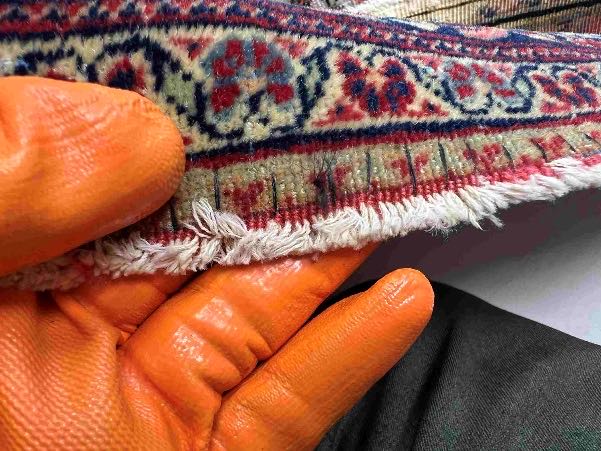
- Turn it over and look at the back: knots, pattern and any repairs.
- Check the ends and sides for loose knots, a worn-through fringe or fraying; see rug fringe repair.
- Look for moth damage under the pile and on the back; see moth damage in wool rugs.
- Fold a corner gently to feel the foundation. It should bend, not crack.
- Smell it. A musty smell can mean damp or old pet accidents.
- Ask for origin, age, materials and condition in writing. Every rug we sell comes with a certificate of authenticity.
- Plan for a professional wash if it has not had one recently; see how a Persian rug is hand washed.
If you own an old rug
If you have inherited or own an old rug and want to know what it is, start with our guide to inherited estate rugs. A certified rug appraisal records its origin, age, condition and value in writing. If it needs care, our restoration follows rules that never make an old rug look younger, because age is part of its value. See rug conservation vs restoration.
See antique and older rugs in person
Browse our antique rugs and all our Persian and Oriental rugs for sale. Each rug's page lists its age, origin and condition, and you are welcome to see any of them in natural light at our showroom at 769 Concord Ave in Cambridge. We offer a free 3-day in-home trial and a lifetime trade-in.
Frequently Asked Questions
How old does a rug have to be to be antique?
A rug is generally called antique when it is about 100 years old or more. A rug of roughly 50 to 100 years is usually called semi-antique.
What is the difference between a vintage and an antique rug?
Antique means about 100 years old or more. Vintage is a looser term, often used for pre-owned rugs from the mid-20th century onward. It describes a used rug with some age rather than a precise date.
Are antique rugs worth more than new rugs?
A good antique in sound condition is usually worth more, because it is scarce. But condition and quality matter as much as age: a damaged or coarse old rug may be worth less than a fine new one.
How can I tell if an old rug has been made to look antique?
Look for uniformly faded colors, dry wool and a back that looks newer than the front. These can be signs of a chemical "antique wash". An appraiser can tell you what a rug really is.
Is it safe to buy a used Oriental rug?
Yes, if you check it first: look at the back, the ends and sides, check for moths and a brittle foundation, and get its origin, age and condition in writing. A professional wash is a good start for any pre-owned rug.