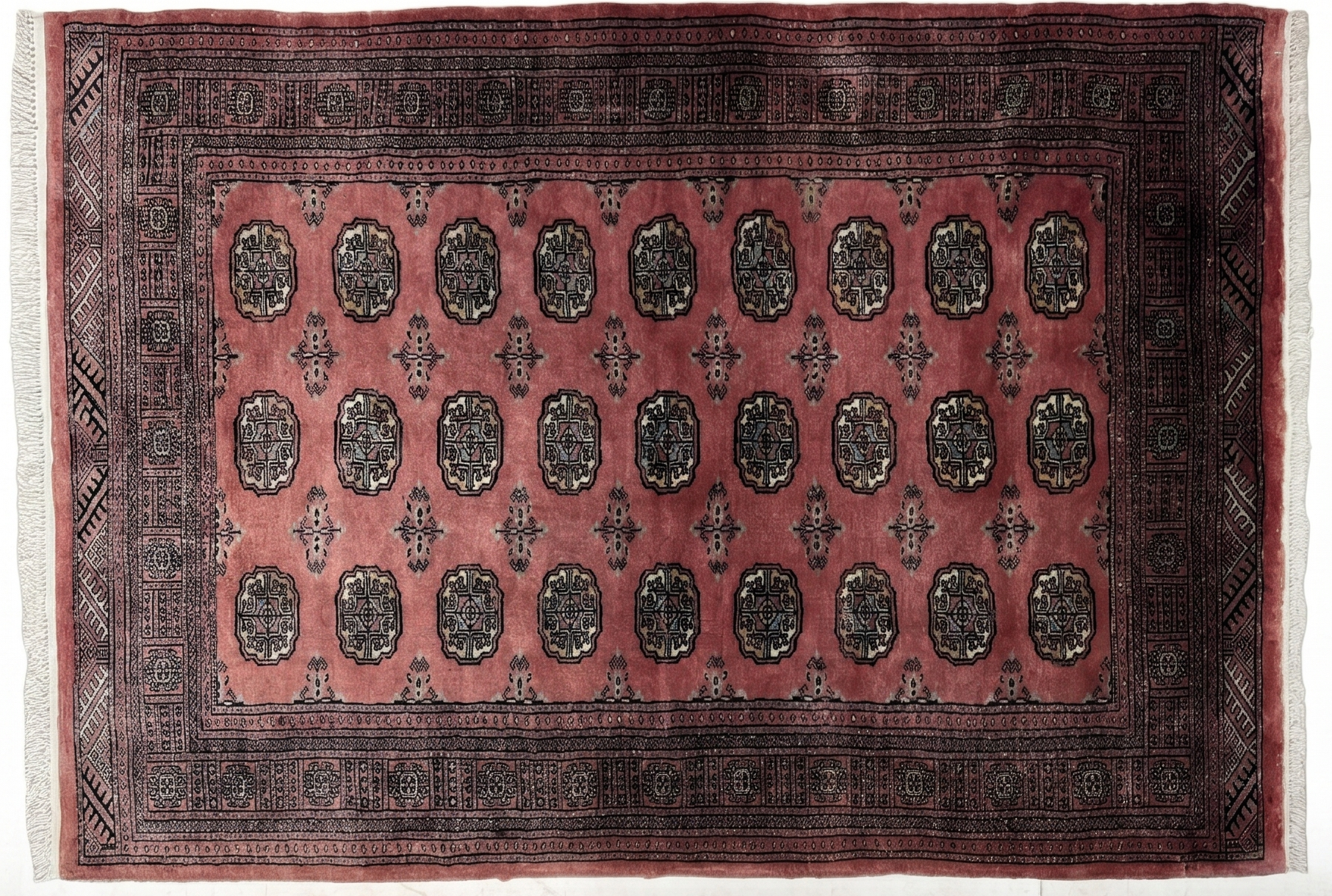
Few rug designs are as easy to recognize as the Bokhara: rows of rounded, many-sided medallions repeated across a deep red field, framed by a band of small geometric borders. It is one of the most popular Oriental rug designs in the world, and one of the most practical. Yet the name causes a lot of confusion, because a "Bokhara" rug was not necessarily woven in Bokhara, and the medallions have a name and a history of their own.
This guide explains what a Bokhara rug is, what its medallions mean, where these rugs are woven today, and how to choose and care for one.
Where the name comes from
"Bokhara" is a trade name. It comes from Bukhara, the historic city in Central Asia, in today's Uzbekistan, which was a great market town on the trade routes between China, Persia and the West. Rugs woven by the Turkmen tribes of the surrounding region passed through its markets, and Western traders came to call them all "Bokhara" rugs, after the place they were bought rather than the people who wove them.
The rugs themselves belong to the weaving tradition of the Turkmen: nomadic and village tribes of Central Asia, each with its own designs, colors and weaving habits. That is why you will see these rugs described both ways. On our site we use both names: Bokhara and Turkmen rugs.
What a gul is
The medallions that repeat across a Bokhara rug are called guls (from a word often translated as "flower"). Each gul is a rounded, many-sided shape, usually divided into four by a cross, with small motifs inside each quarter. They are arranged in neat rows, often with smaller secondary motifs between them.
For the Turkmen tribes, the gul was more than decoration. Each tribe had its own gul designs, used much like an emblem, so the shape of the gul is one of the clues to where a rug comes from. Among the best known is the Tekke gul, the rounded, quartered medallion most people picture when they think of a Bokhara rug. Over time, as the design spread and was woven by many groups and in many countries, the forms were shared and simplified, and today the gul is best understood as the signature of a tradition rather than proof of a particular tribe.
The design has no single center. Because the guls simply repeat, a Bokhara rug looks right from every side, which is one reason it is so easy to place in a room.
Colors and materials
The classic Bokhara color is red, from a deep, almost brown red to a bright rose. Traditionally these reds came from madder root, one of the great natural dyes; you can read about it in Natural Dyes in Persian and Oriental Rugs. Guls and borders are drawn in dark blue, black, ivory and touches of orange or green. Some newer Bokharas come in other ground colors, such as ivory, gold, blue or green, but red remains the classic.
Turkmen rugs are usually woven with a wool pile, and older pieces in particular often have a lustrous, finely clipped wool that feels smooth to the hand. Good wool matters as much here as in any rug, as we explain in our article on mountain wool.
Where Bokhara rugs are woven today
The Turkmen tradition is woven across a wide region today: in Central Asia, in Afghanistan and in Pakistan, among other places, by Turkmen weavers and by others working in the same designs. Our collection includes both antique and newer pieces, and each rug's page states its origin and age, so you know exactly what you are buying.
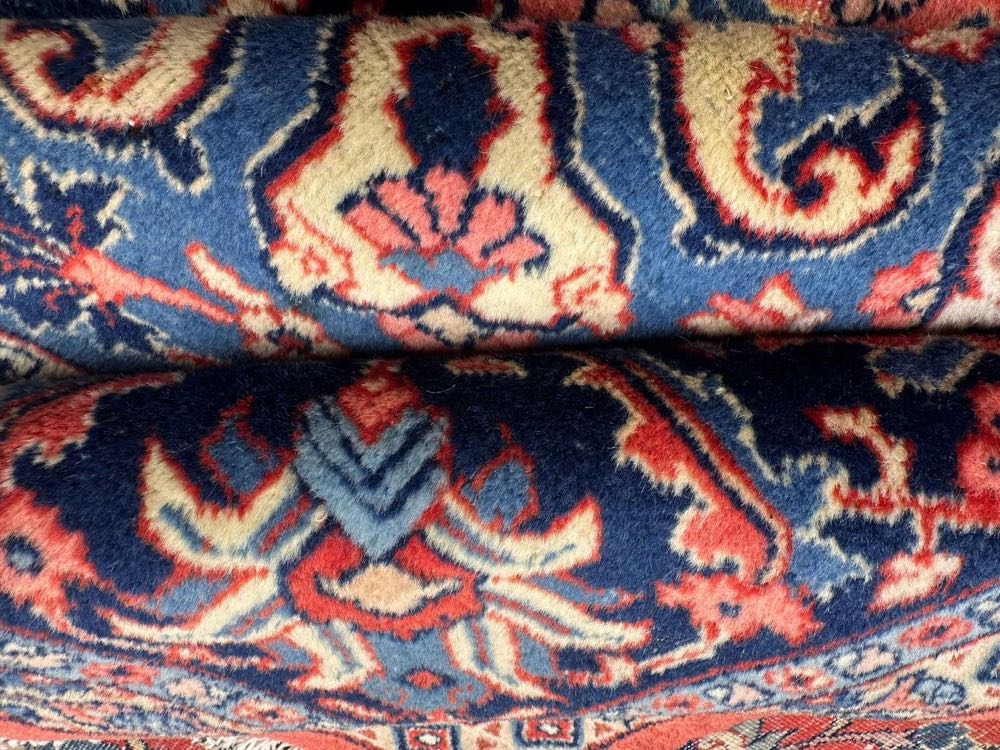
A Bokhara-design rug can be a true hand-knotted rug wherever it is woven. What matters is that it is hand-knotted, with good wool and dyes, and that its origin is stated honestly. Our article on how to tell an authentic handmade rug explains the checks, including the most reliable one: turn the rug over and look for the knots and the pattern on the back.
Antique and newer Bokharas
Older Turkmen rugs often show softened, mellowed reds and gentle abrash, the shifts of shade that come from wool dyed in small batches. Collectors value good antique Turkmen weaving, and a fine old piece in sound condition is scarce. Some wear is part of an antique's character, as we explain in Beautiful "Flaws" in Persian Rugs, but moth damage, holes and loose ends need attention. A certified rug appraisal records an older rug's origin, age and value in writing. See also our antique rugs.
Newer Bokharas have crisper colors and a cleaner, more regular drawing. They are an excellent choice for a room that sees everyday use, and they offer the look of the tradition at a wide range of prices. Our article on why handmade rugs cost more explains what separates one from another.
Where a Bokhara rug works
- Living rooms and family rooms: the repeating pattern has no single center, so it is forgiving of furniture placed on it.
- Studies, libraries and dining rooms: deep reds suit wood, leather and books.
- Hallways and entries: red fields and small-scale patterns hide everyday wear well, and Bokhara runners are a classic choice.
- Modern rooms: the orderly, geometric design sits well with plain, modern furniture.
For help with sizes, see our guide to what size rug for each room.
Caring for a Bokhara rug
Vacuum regularly without a beater bar on the pile, turn the rug end to end once or twice a year so it wears evenly, use a rug pad on hard floors, and keep it out of strong, direct sun, which fades reds faster than any other color. Have it professionally hand washed every 3 to 5 years; red dyes in particular should be color-tested before a rug is washed, which is the first step of our 7-step cleaning process. See how often to clean a Persian rug and why rug colors run or fade.
Frequently Asked Questions
What is a Bokhara rug?
"Bokhara" is the trade name for rugs in the Turkmen tradition of Central Asia, with rows of repeating medallions, called guls, usually on a red field. The name comes from Bukhara, the old market city where many of these rugs were traded.
Are Bokhara rugs Persian?
Not usually. The Bokhara design belongs to the Turkmen tradition of Central Asia, and today it is woven in Central Asia, Afghanistan, Pakistan and elsewhere. Each of our rugs' pages states its country of origin.
What does the gul on a Bokhara rug mean?
The gul is the repeating medallion. Each Turkmen tribe traditionally had its own gul designs, used much like an emblem, so the shape is one clue to a rug's origin. Today the gul is best seen as the signature of the Turkmen tradition.
Are Bokhara rugs good for high-traffic areas?
Yes. The repeating pattern and red field hide everyday wear well, which makes Bokhara rugs a good choice for living rooms, hallways and entries. A good wool pile matters most.
How do I clean a Bokhara rug?
Vacuum it regularly without a beater bar and have it professionally hand washed every 3 to 5 years. Red dyes should be color-tested before washing, and a Bokhara rug should never be steam cleaned.